

Quad Adventure to Bjelasnica & Lukomir Village
Embark on an off-road adventure in the Olympic Mountains on a quad bike. Visit the ethno villages of Lukomir and Umoljani and see the Rakitnica Canyon.

Bosnia and Herzegovina is home to extraordinary cultural and natural diversity. UNESCO has recognized five sites – three cultural and two natural – which together form a living panorama of history, mythology, architecture and evolution. They tell of empires that came and went, of people who built bridges and connected worlds, and of a nature that has maintained its own rhythm for thousands of years.
These sites are not museums. They are open, breathing chapters of a country that visibly bears its past and shapes its future with the awareness of these old layers.
The Old Bridge of Mostar is a structure that hovers between two banks like a single breath. Its history begins in the 16th century, when the Ottoman administration decided to replace the existing wooden bridge with a permanent stone arch.
The architect Mimar Hayruddin, a student of the legendary Mimar Sinan, created a bold design:
a single, 28.7-metre-long, extremely slender arch made of local limestone that spans the Neretva in a single sweep.
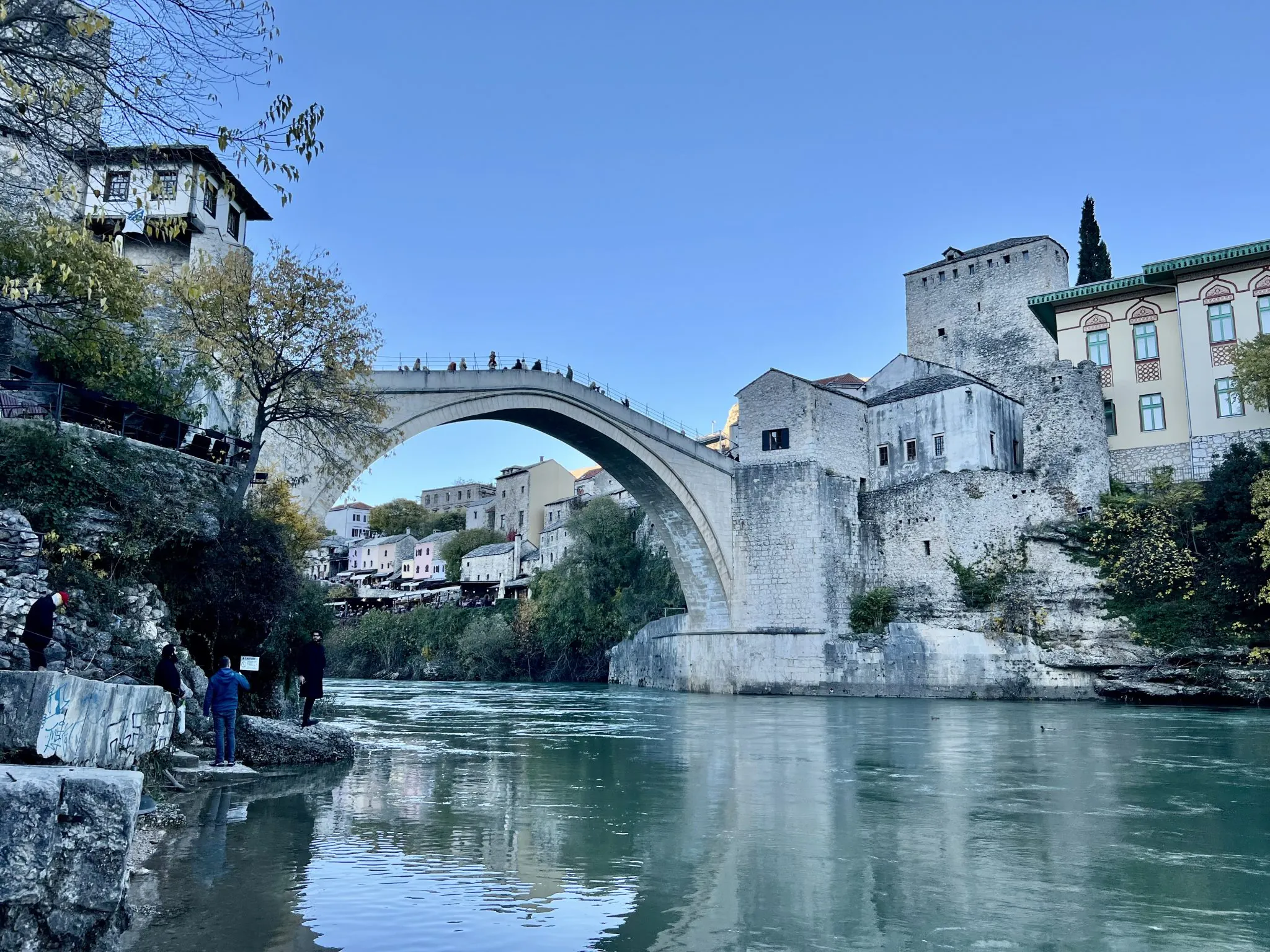
Construction was considered almost impossible. Contemporary sources report that Hayruddin feared that the bridge would collapse when the scaffolding was removed. But it held – and stood intact for over 400 years in the middle of a city that developed culturally, religiously and architecturally into a mosaic.
Its destruction on November 9, 1993 was a shock far beyond the country’s borders. The bridge fell into the River Neretva under fire – a moment that reminded the world just how vulnerable cultural heritage is. For the people of Mostar, its loss was more than the collapse of a structure: it was the tearing apart of a symbol of coexistence and connection.
The reconstruction between 1997 and 2004 was an international project involving archaeologists, engineers and stonemasons from many countries.
The construction method was reconstructed as faithfully as possible:
– same building materials, especially the local limestone “tenelija”
– historical techniques, including traditional wedge joints
– reconstructed foundations of the old pillars
– recourse to original Ottoman sources
The result was a bridge that was not modernized, but reborn – a continuation of the original, not a copy.
The Old Bridge of Mostar is a technical and aesthetic masterpiece:
– The single arch: A 29-metre-long, extremely flat arch without intermediate supports – revolutionary in its time.
– Elegant tension: The arch appears almost weightless; it balances the forces so precisely that the transition between stone and sky is barely perceptible.
– Integration into the city: The bridge connects two parts of the city that rise in terraces above the river. Architecture, topography and river landscape merge into an overall picture.
– Symbolic function: There were many bridges in the Ottoman Empire – but none with this iconic silhouette, which became a symbol of connection in the midst of cultural diversity.
Today, the bridge stands not only as an architectural masterpiece, but also as a monument to resilience: it collapsed – and rose again.
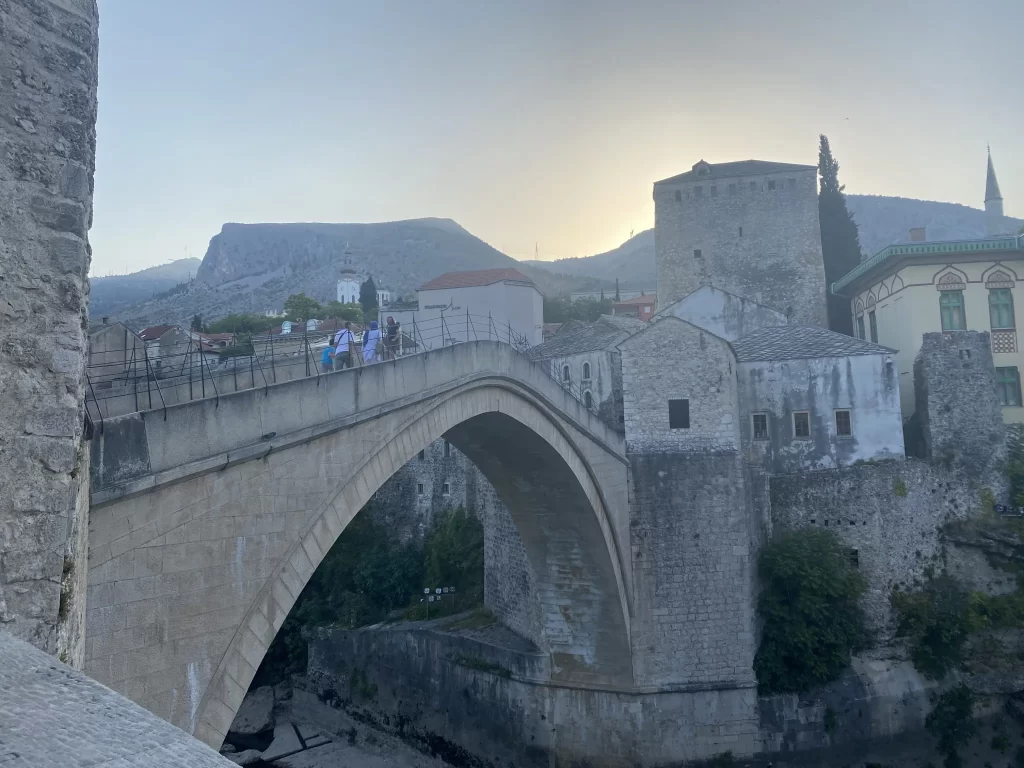
Just a few steps away from the Old Bridge is its older and much smaller “sister”: the Kriva ćuprija – the Leaning Bridge. It was built in 1558, eight years before the famous Stari Most, over the Radobolja stream.
It is often said that Mimar Hayruddin undertook a kind of architectural trial run here before daring to build the bold great arch over the Neretva. Even if this attribution is not historically proven, the shape of the bridge is so similar to the later Master Bridge that it is still considered its small model today.
Today, the area around Kriva ćuprija is a popular meeting place, especially in the warmer months. Between the old stone houses, the murmur of the Radobolja stream and the romantic lighting, open-air concerts, small festivals and improvised music evenings take place in summer. The atmosphere is relaxed, creative and full of life – almost as if the little bridge itself is swinging to the rhythm of the music.
The Kriva ćuprija shows how ingeniously Ottoman architecture was conceived even in the byways of a city: harmonious, functional and poetic at the same time. It turns Mostar’s old town into an ensemble in which even the “smaller” buildings tell great stories – and bring people together again today.

UNESCO since 2007
This elegant stone bridge from the 16th century, designed by Ottoman architect Mimar Sinan, is considered a masterpiece of its time. Eleven arches span the Drina and bear the weight of changing eras – from the Ottoman Empire to modern Bosnia and Herzegovina.
Ivo Andrić immortalized the bridge in his world-famous novel The Bridge over the Drina, an epic panorama spanning four centuries. The novel follows the lives of the people of Višegrad – Christians, Muslims and Jews – and shows how political upheavals, wars, festivals and everyday stories are condensed around the bridge.
The bridge appears as a symbol of connection, change and memory: a silent witness to human destinies between empire and modernity.
Andrić was awarded the Nobel Prize for Literature in 1961 for his complete literary oeuvre, of which this work is a central pillar.

UNESCO since 2016

The Stećci are located where the medieval Bosnian kingdom once formed its cultural landscape – spread across plateaus, forests and valleys that today seem quiet, but were once the spiritual and social heart of the country. Between the 12th and 15th centuries, more than 70,000 of these monolithic tombstones were created.
Today, they are preserved in four countries:
Bosnia and Herzegovina (the largest number), Croatia, Montenegro and Serbia – a geographical echo of their historical distribution.

Their inscriptions and reliefs are full of philosophy and quiet wisdom. Many are reminiscent of ancient Egyptian ideas of transition and Gnostic ways of thinking, in which the duality of light and shadow, body and soul, this world and the hereafter play a central role.
In them, man appears as a traveler between worlds – rooted in the earth, but always turned towards the hereafter.

The depictions range from everyday scenes – dancing figures, horsemen, hunters – to mythical creatures. They also include dragons, which play a key role in many local legends in Bosnia and the Western Balkans: as guardians of the mountains, as symbols of primal forces or as creatures that embody chaos and new beginnings at the same time.
This mixture of real life and mythical imagination makes the Stećci unique in Europe.
The stećci are not mere tombstones. They are stone narratives – about world views, beliefs, identity and the philosophical depth of a medieval culture that was far more than what was later written about it.
UNESCO since 2007 (extensions 2011, 2017, 2021)
Bosnia and Herzegovina is one of the most densely forested countries in Europe: over 50% of the country’s surface area is covered by forest, a proportion that is well above the EU average. These forests are not only a resource, but also a habitat, climate regulator, mythological backdrop and one of the last retreats of truly original European nature.
Within these vast areas of forest lie the UNESCO-protected primeval beech forests, remnants of the huge forest zones that have spread since the end of the last ice age around 12,000 years ago. Their development is a living archive of evolution: every trunk, every root canal, every moss cushion tells of thousands of years of ecological adaptation – without large-scale human intervention.

But it is precisely these forests that are under threat today.
Illegal logging, often organized and difficult to control, has a deep impact on their structure. Entire ecosystems are thrown out of balance:
– rare plants disappear,
– endemic insects and amphibians lose their habitat,
– old giant trees – biological memory stores – are irretrievably destroyed.

With them, the flora and fauna, which are among the last largely intact in Europe, are also under pressure. Many species that have long since disappeared in Central Europe still find safe havens here: lynx, wolf, wildcat, capercaillie, rare lichens and countless microorganisms that stabilize the ecosystem.
The Bosnian beech forests are therefore more than just a natural monument.
They are a repository of European natural history – and a reminder that even millennia-old ecosystems cannot be taken for granted. Protecting them is protecting our own past and future.
UNESCO since 2024
The Vjetrenica Cave is the largest karst cave system in the Dinaric Mountains – an underground realm of stone, water and ancient silence. Its name means “the windy one”, and it is meant literally: even when it is over 30 degrees outside, an icy cold breeze flows out of the cave entrance, as if the earth itself were breathing in and out deeply. This breath is constant, day and night, summer and winter.

Inside, a world unfolds that seems almost fairytale-like. Stalactites and stalagmites are reflected in crystal-clear pools of water, making their shapes appear like dancing silhouettes – a natural ballet of stalactites and light. The air is crystal clear and humid, almost medically pure; many visitors feel that breathing becomes easier, as if the cave is relieving the lungs.
Vjetrenica is home to one of the richest underground biodiversities in Europe: over 200 endemic species, including the blind, almost mythical cave olm. Down here, evolution has found its own mysterious language.

At the end of the tour, a small miracle of nature awaits: a fountain with a thin thread of pure water falling from its ceiling. It is rainwater that has seeped hundreds of metres through the limestone – slowly filtered, mineralized and purified. To hold this water in your hands and drink it is to touch the essence of the Dinaric Karst.
More purity, more health, more nature is hardly possible.
Vjetrenica is no ordinary cave. It is a place where time slows down, the light becomes restrained and the earth shows how old and alive it really is.
Together, these five sites show that Bosnia and Herzegovina is a country full of layers: a space where cultures meet, nature remains true to itself and history is written in stone, water and forest.
They are living places of remembrance – and a promise of how much beauty and knowledge is preserved in this small country.

There are places you can see – and places you have to feel.
Bosnia and Herzegovina is one of those countries that do not tell their stories out loud. They whisper. From stone, from water, from forest and from those mythical layers that lie deep beneath the visible world.
With Superb Adventures Tours we open doors to precisely these spaces.
We travel to bridges that have outlasted empires. To stećci that lie in the grass like stone manuscripts full of wisdom and symbolism. To forests that have been breathing since the Ice Age. And to the Vjetrenica Cave, where stalactites dance and the earth shares its cool breath with us.
Each of our tours is more than just an excursion.
It is an invitation to see with different eyes – the mysticism in the landscape, the ancient traces under your own feet and the silent power that inhabits this land. Guided by people who grew up here, who know the legends, can read the rivers and share their stories with you.
If you are ready not only to visit Bosnia and Herzegovina, but to experience it,
then join us on a journey that goes deeper than any map.
Superb Adventures Tours – where nature, culture and myth come together.
Book directly here.
A curated list of the most popular travel packages based on different destinations.

Embark on an off-road adventure in the Olympic Mountains on a quad bike. Visit the ethno villages of Lukomir and Umoljani and see the Rakitnica Canyon.
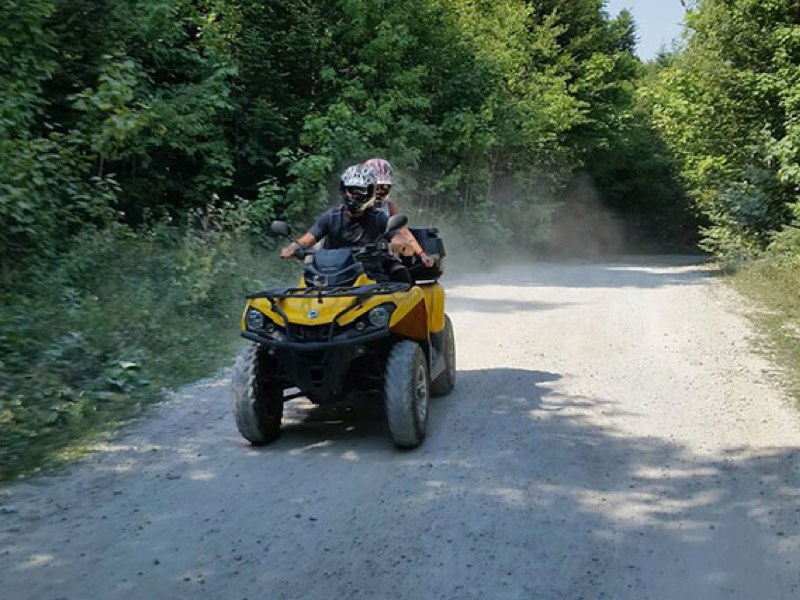
Some happy moments… Bjelašnica is a mountain in central Bosnia and Herzegovina. It is found directly to the southwest of Sarajevo, bordering Mt. Igman. Bjelašnica’s tallest peak, by which the whole mountain group got its name, rises to an elevation of 2067 meters (6782 feet).